
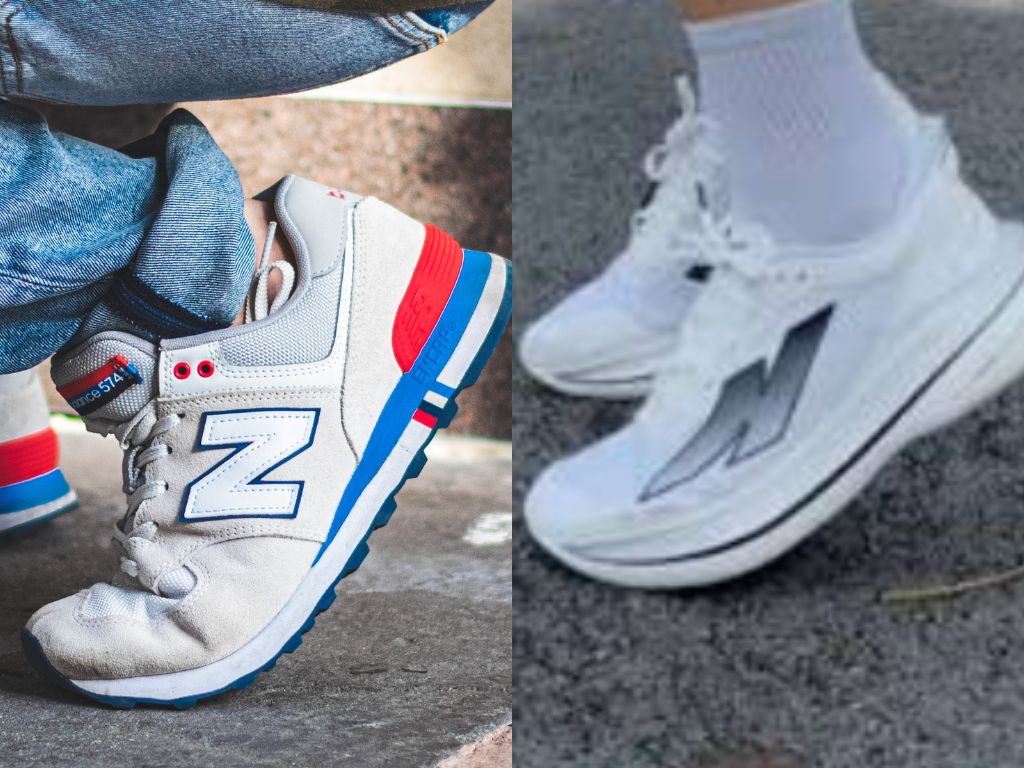
In the athletic footwear market, a single stylized letter placed on the side of a sneaker can be worth billions. Take New Balance. For decades, the Boston-based footwear company has built its global brand identity around its iconic, angled “N” logo.
Because of this, New Balance filed a federal trademark infringement lawsuit in the U.S. District Court for Massachusetts against French sporting goods giant Decathlon in September. Their complaint? The stylized emblem used on Decathlon’s “Kiprun” line of performance running shoes infringes upon and dilutes New Balance’s signature “N” mark.
You read that correctly — New Balance is arguing that Decathlon’s “K” infringes on their “N.”
Real-World Context and Confusion after the Sale
While Decathlon understandably maintains that its design is simply a stylized letter “K,” the lawsuit exposes a complex trademark dilemma: what happens when a logo looks distinct on paper… but acts like a competitor’s mark when mirrored, angled, and viewed in the real world?
New Balance’s complaint argues that because shoe manufacturers place logos on both the lateral (outer) and medial (inner) sides of footwear, the design is frequently flipped or mirrored.
Why does this matter?
Because, at least according to the filing, when Decathlon’s stylized “K” is mirrored or viewed from specific angles while being worn, it creates a visual silhouette that is “unmistakably an N.”
To bolster its claim, New Balance introduced evidence of actual consumer reaction. Specifically, they cited social media posts and online comments. In them, shoppers explicitly noted that Decathlon’s new running shoes looked like New Balance footwear.
This strategy leans heavily into the doctrine of post-sale confusion. Under federal trademark law, actionable confusion does not just happen at the cash register. Infringement can also occur post-sale, when members of the public see the product and falsely believe it was designed, manufactured, or endorsed by the original trademark owner.
Dilution and the Power of Single-Letter Marks
Beyond traditional likelihood-of-confusion claims, New Balance is asserting claims for trademark dilution.
Under the federal Trademark Dilution Revision Act (TDRA), owners of truly famous marks can stop competitors from using similar designs even if consumers are not immediately confused about the source of the product.
Dilution occurs when a third party’s use “whittles away” or blurs the distinctiveness of a famous mark over time.
Single-letter trademarks are notoriously difficult to protect because they are inherently common. However, through decades of exclusive commercial use, massive advertising expenditures, and continuous enforcement, New Balance has established that its slanted “N” holds widespread secondary meaning.
Allowing a global competitor to market running shoes with a mirrored emblem that mimics that same visual footprint? That would pose a direct threat to the exclusive commercial value of New Balance’s primary asset.
Key IP Takeaways for Designers and Enterprise Brands
The New Balance v. Decathlon litigation offers essential risk-management lessons for businesses clearing new logos or expanding product lines:
Clear Marks in Real-World Contexts. Trademark clearance audits cannot stop at static, 2D graphic comparisons. For physical products (especially things like apparel, footwear, and accessories), designers and legal teams must evaluate how a logo looks when mirrored, repeated, embroidered, or viewed from different angles when worn in motion.
Post-Sale Confusion Is a Real Legal Threat. Uniqueness at the point of sale will not protect a business if the product creates visual confusion in the wild. When a design looks confusingly similar to a competitor’s famous mark from 10 feet away, you face immediate legal exposure.
Social Media Is Real-Time Evidence. Modern trademark litigation relies heavily on organic consumer feedback. When consumers on forums, social media platforms, or review sites comment that a product “looks just like [Competitor],” that creates immediate, discoverable evidence of actual confusion that can be used in court.
As athletic brands continue to push the boundaries of minimalist logo design, the boundary between a “K” and an “N” serves as a reminder: in trademark law, consumer perception in the marketplace always overrides artistic intention.
Are you navigating a trademark dispute, clearing new product logos, or seeking to protect your core visual assets in the global marketplace? Safeguard your enterprise by contacting our experienced intellectual property team.